
Dead Words
Why Your Political Vocabulary Is Obsolete

A few weeks ago I promised you a working vocabulary.
I’d been reading the scholars and talking with historians and deep thinkers and considering the current moment through a different lens. Patrimonialism, neo-royalism, tech-Hamiltonian coalitions. Not typical analysis for someone trained in ward politics and gross rating points.
I said I was working on language that could translate those structural shifts into something people could actually use.
“Houses” to describe how power organizes now.
“Subjects” to describe how individuals experience their relationship to that power.
Then I took a detour to argue with Nate Silver. That was fun. But now I’m back.
Before I give you the new words, I need to bury some old ones. Not bad words. Not strategically wrong words. Dead words—terms that assume a system that no longer exists. Words that keep smart people navigating by a map that no longer matches the territory.
You know these words. You’ve probably heard them this week. Democratic leadership definitely used them.
“Affordability.”
The theory is solid. Meet voters where they live. Kitchen table issues. Don’t lead with Trump. I made this exact argument a hundred times. Built campaigns around it.
And now, watching strategists workshop whether inflation is 2.2% or 3.2%, I keep thinking about Allen Iverson. “We talking about practice, man. Not a game. Practice.”
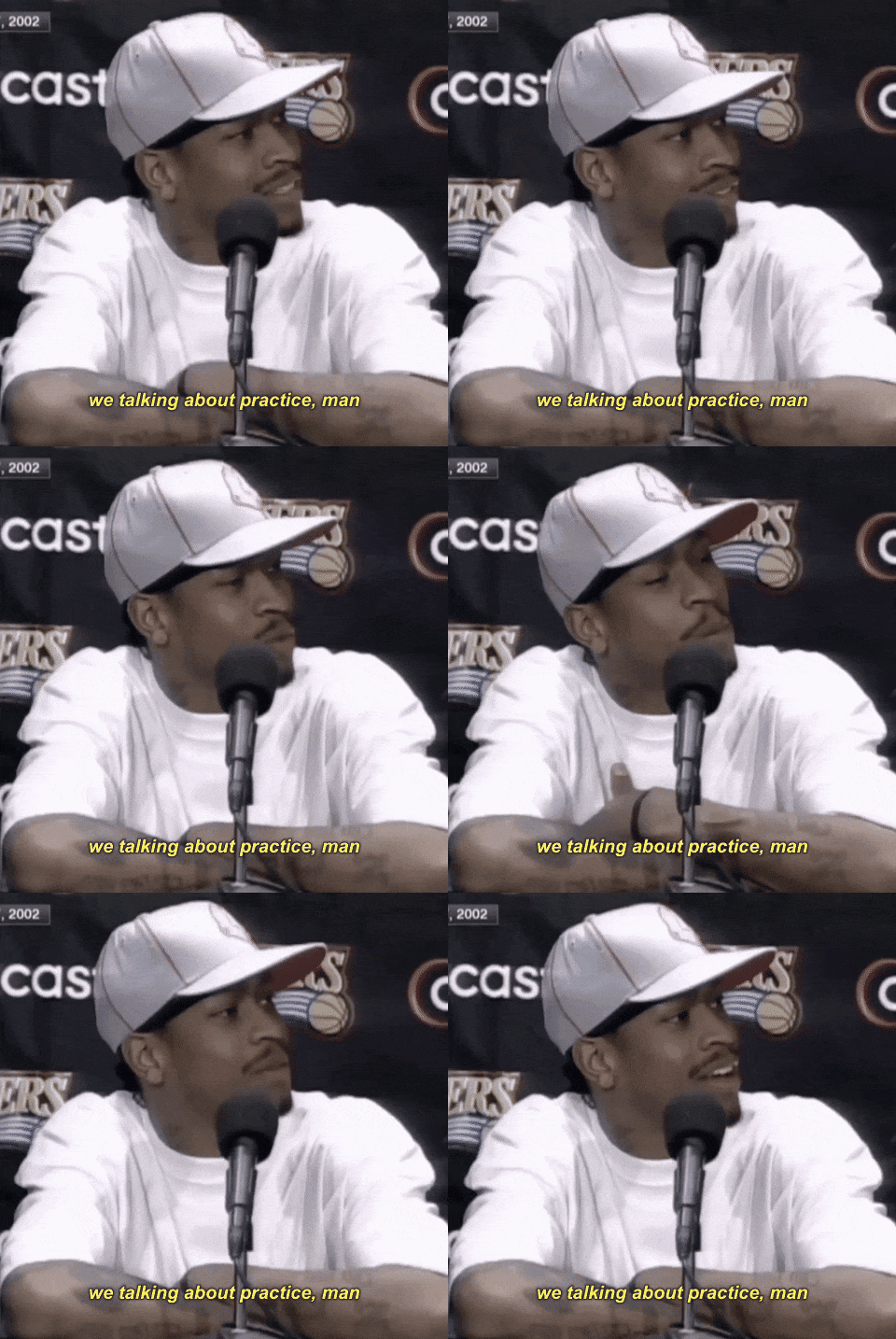
We’re talking about the price of eggs and bananas while a handful of mega-billionaires rewrite the economy in real time. While AI forces us to reimagine what work even means. While your 40-year-old neighbor with the graduate degree watches their professional value evaporate.
I wrote a book arguing that human strategic thinking was the irreplaceable skill in an age of automation. It came out in May 2024. By that summer, agentic AI had made its central thesis obsolete. My own argument about human value couldn’t survive contact with the speed of displacement.
You want to talk about affordability to people watching their careers dissolve? You want to debate grocery prices while the future of work gets restructured without anyone’s input?
Practice. We’re talking about practice.
“Norms.”
As in, “we need to restore them.” Restore them where?
Federal agents have shot people in American cities. The president threatened to invade a NATO ally. DOGE—an unelected body run by the world’s richest man—tore up the federal workplace without congressional authorization. The norms aren’t violated. They’re irrelevant.
Compare two responses to the same moment. Friedrich Merz, the German Chancellor, speaking about America:
“No one forced us into the excessive dependence on the United States... This immaturity was our own fault. But we are now leaving this situation behind us, and sooner rather than later.”
That’s a leader naming reality and acting on it.
Hakeem Jeffries, House Democratic leader, last spring:
“I’m trying to figure out what leverage we actually have. It’s their government.”
Jeffries, days after an ICE agent shot Renee Good in Minneapolis:
“We’ll figure out the accountability mechanisms at the appropriate time.”
Read those together. He named the architecture a year ago — and then kept operating inside it.
The leader of the opposition party in the most powerful democracy on earth said, out loud, that he doesn’t know what leverage he has. That the government belongs to someone else.
He’s not wrong. That’s what makes it devastating. He named the architecture accurately—and then kept operating as if the old vocabulary still applied. As if “norms” meant something.
Merz saw the shift and changed strategy. Jeffries saw the shift and shrugged.
“Checks and Balances.”
Jeffrey Epstein’s files exist. Over three million pages of them. Flight logs. Contacts. Evidence.
In Europe, that evidence produced consequences. Prince Andrew stripped of duties. Turkey and Lithuania launching trafficking investigations. Political figures facing real accountability.
In the United States, Congress held hearings. The hearings produced revelations. The revelations produced more hearings. The DOJ released documents, then announced no one else would be charged. An enormous amount of evidence converting into exactly zero consequence. That’s not checks and balances. That’s a hamster wheel with cable news cameras on it.
“Vote.”
I’m not saying don’t vote. I’m saying that using “vote” as a complete sentence—as though the act of voting is sufficient to produce democratic accountability—requires believing the system converting votes into governance is still functional.
This is the default position of a political class that wants more of the same. The midterms will fix it. The pendulum will swing back. I made this argument for thirty years. I’m having trouble making it now. Not because I’ve become cynical. Because I’ve been paying attention.
PS — You can add “abundance” to the list while you’re at it.
Practice. We’re talking about practice.
What’s Left After the Autopsy?
So what language honestly describes a system where public opinion is measured constantly and constrains nothing? Where a Democratic leader can say “it’s their government” and nobody blinks because everyone knows it’s true?
I keep arriving at the same place. One by one, I crossed off every framework I spent my career building. And what remained—after “affordability” became practice, after “norms” became decoration, after “checks and balances” became performance, and after insiders like Ezra Klein dropped “Abundance” into the mix —was language I never expected to use.
Houses and Subjects.
When power consolidates around family dynasties, personal loyalty networks, and corporate-government fusions operating outside constitutional authority—those are Houses. House of Trump. House of Musk. House of Saud. House of Murdoch.
The fusion that turned DOGE into a policy instrument without a single congressional vote and recently led to a $187 million sweetheart deal that landed right in the lap of the Trump family.
And when citizens engage politically—vote, protest, petition—and that engagement is processed through the performance of democratic ritual but never actually leads to a constraint on power?
That’s not citizenship. That’s Subjects petitioning the court.
Citizens decide. Subjects petition.
Right now, Americans are petitioning passionately with the most sophisticated technology in history. And the court receives the petitions, files them, and proceeds.
The Lucidity of the Rebel
Naming the architecture doesn’t tell you what to do next. But it changes the questions you ask.
One of my closest pals — a fellow traveler who spent as much time in the gears as I have — recently described our role in politics as having been “apparatchiks.”
It struck me because it’s the honest word. I spent thirty years as a functionary of an apparatus I believed was a Republic. I wasn’t just watching the game; I was helping maintain the machinery. I thought if the apparatus was tuned well enough, if the inputs were smart enough, it would produce democratic results.
I was right. For a while. And then I wasn’t — not because I stopped being a good apparatchik, but because the machine was replaced by an architecture of Houses while the old rules stayed posted on the wall.
Facing this kind of change usually leads to one of two places: false hope or doomerism. I’m not interested in either.
Camus called the alternative lucidity — clear sight without the comfort of pretending the old map still works. But Camus was a philosopher. I’m a practitioner. So what I’m working toward is something messier: a blend of his framework and thirty years of learning how power actually moves. Not theory. Not tactics. Something in between — a way of seeing that leads to a different set of questions.
As a Citizen, you look for consensus. As a Subject, you look for friction.
You look for the places where the Houses are brittle. Where their efficiency depends on your acquiescence. Where their “agentic AI” requires your data and your seamless, silent cooperation. Where the House of Musk and the House of Trump rub raw against each other in the halls of power.
Subjects ask different questions: Where does power actually sit? Whose protection do I depend on? What are the real costs of refusal?
I’m not ready to answer those questions yet. But I’m increasingly sure they’re the right ones to ask.
What comes after naming the architecture — what action looks like, what systemic change requires — is where this is heading. Not messaging. Not mobilization. Something harder.
That’s next.
Steve, I had to read it three times but I have to say it’s really really really that’s it that I own yet? — brilliant. In concept, in execution and words that I dare not use here right now for the reasons. See you around the campus. Looking forward to it. Wanna have coffee on these days?
Affordability wasn't obsolete in the NYC mayor campaign. But I'll grant your premise that it is in the mouths of national Democrats nakedly trying to bottle Mamdani's magic. What do you think is the difference?