
Name the Houses
A practitioner’s manifesto for the moment we’re in

I am not a pundit. I am not an academic. I’m an apparatchik — a loyalist, a believer, an LA guy who did some Philly ward politics, managed a few campaigns and spent thirty years around the Democratic machinery because I thought the machinery worked. I sat in rooms where decisions got made and watched how they got made.
I named my agency Message because I believed that the right message, delivered with discipline to the right people at the right moment could move behavior.
It worked. For a while.
I am not writing this as a partisan. I am writing this as someone who is watching candidates and causes I worked for become incapable of doing the one thing that would save them — and watched them choose, repeatedly and deliberately, not to do it.
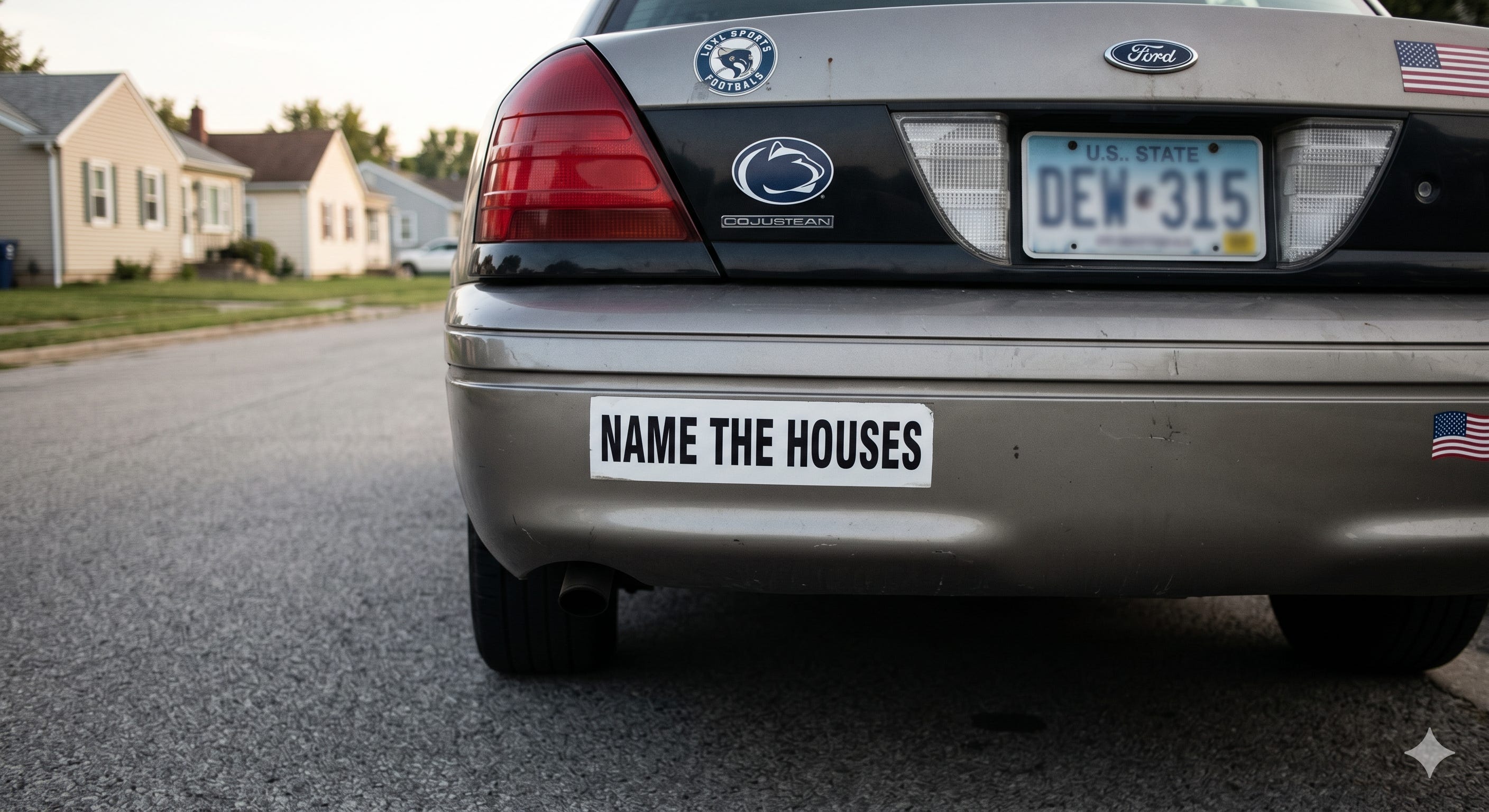
We just saw a man topple sixteen years of authoritarian rule in Hungary with the largest electoral mandate in his country’s democratic history. He may not be a perfect fit for our American moment, but he knew what Democrats have forgotten, or never learned, or chosen to ignore — and it is simple enough to fit on a bumper sticker:
Name the Houses.
Not “the system.” Not “special interests.” Not “the wealthy” or “the elites” or any other abstraction that lets the guilty parties sleep at night.
The Houses. The specific families. The specific people.
The specific decisions that broke the specific promises made to specific Americans who showed up and worked and played by the rules and got nothing back.
That’s the argument. Everything else follows from it.
I. We Have Been Here Before
Not once. Twice. At least in the previous century.
In 1856, the abolitionist John Brown fought a battle in a small Kansas town called Osawatomie against forces trying to make slavery permanent in America. The blood soaked into the ground.
Fifty-four years later, Theodore Roosevelt chose that ground deliberately. He stood in Osawatomie and delivered what became known as the New Nationalism speech. He had been president. He had been inside the machinery. He knew exactly how it worked and who it served. And he chose that particular field — the field where the fight against one form of concentrated, dehumanizing power had been joined — to name another.
He argued that every man holds his property subject to the general right of the community.
He named the railroads. He named the trusts. He named the financiers.
He didn’t call them “the system.” He called them what they were: people who had taken more than they were owed and used their excess to buy the machinery of government.
He didn’t do it alone. The muckrakers had been at work for years — Upton Sinclair naming the meatpackers, Ida Tarbell dismantling Standard Oil, Lincoln Steffens mapping the corruption of city governments. Journalists and writers had done the diagnostic work.
What TR provided was something different: political standing. The willingness of someone who had been inside the machinery to name it from within. That combination — the documented evidence and the insider witness — is what made the naming stick.
He kept going.
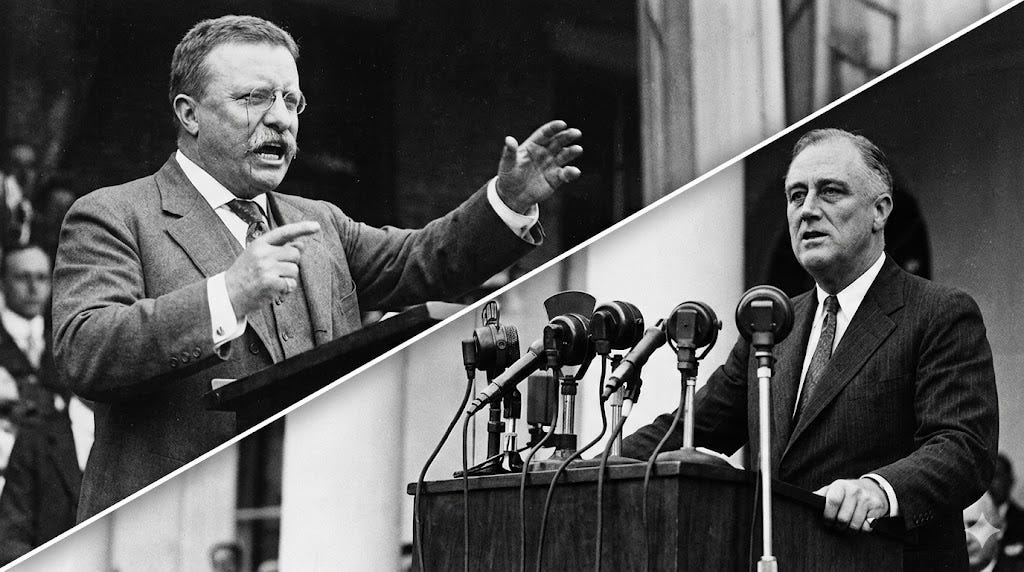
Twenty-six years later, Franklin Roosevelt stood before the Democratic National Convention in Philadelphia and named them again.
Philadelphia is a good city in which to write American history. Political tyranny was wiped out there on July 4, 1776. Roosevelt understood the choice of ground.
He had come to Philadelphia to name a new tyranny.
He called them economic royalists. And he didn’t reach for abstraction:
“For out of this modern civilization economic royalists carved new dynasties. New kingdoms were built upon concentration of control over material things. Through new uses of corporations, banks and securities, new machinery of industry and agriculture, of labor and capital — all undreamed of by the fathers — the whole structure of modern life was impressed into this royal service.”
He named what they had taken:
“The savings of the average family, the capital of the small business man, the investments set aside for old age — other people’s money — these were tools which the new economic royalty used to dig itself in.”
He named what that concentration had done to everyone else:
“A small group had concentrated into their own hands an almost complete control over other people’s property, other people’s money, other people’s labor — other people’s lives.”
And then he named what they had done with that control:
“It was natural and perhaps human that the privileged princes of these new economic dynasties, thirsting for power, reached out for control over Government itself. They created a new despotism and wrapped it in the robes of legal sanction.”
When they complained, he answered them directly:
“These economic royalists complain that we seek to overthrow the institutions of America. What they really complain of is that we seek to take away their power.”
And then, four months later, at Madison Square Garden, on the last night of the campaign, he said the line that every Democrat in America should have somewhere visible:
“They are unanimous in their hate for me — and I welcome their hatred.”
He won forty-six states.
He also said something that night in Philadelphia that has not aged a day:
“There is a mysterious cycle in human events. To some generations much is given. Of other generations much is expected. This generation of Americans has a rendezvous with destiny.”
Read that. Then ask yourself what the Democratic Party has done with that rendezvous.
Both moments — TR at Osawatomie, FDR in Philadelphia — came after periods of consolidation that looked permanent. That looked inevitable. The railroads and the trusts and the financial dynasties of the Gilded Age looked as unassailable in 1910 as the Houses look today.
They weren’t permanent. They ended the moment someone with standing named them out loud and refused to apologize for it.
II. Where We Are
Here is where we stand in April 2026.
The President of the United States threatened to destroy a civilization and backed down with eighty minutes to spare. Gas prices are soaring. A war ended roughly where it started. Tariffs are hollowing out household budgets. By every conventional measure, the opposition party should be surging.
It isn’t.
The Democratic Party is less popular than the president it opposes. A Democratic pollster — not a conservative critic, a Democratic pollster — said it plainly: “The Democratic brand is so bad that they don’t have the credibility to be a critic of Trump or the Republican Party.”
That is not a messaging problem. That is a party that has lost the right to name the enemy because it hasn’t been willing to name itself.
The Italian political philosopher Antonio Gramsci called moments like this the interregnum — the crisis that consists precisely in the fact that the old is dying and the new cannot be born. In this vacuum, he wrote, a great variety of morbid symptoms appear. The Houses are a morbid symptom. They are not the new order. They are what fills the vacuum when the social contract breaks and nobody names it — when institutions that were supposed to mediate between concentrated power and ordinary people get outrun rather than destroyed.
Democratic institutions operate at human speed. Power now moves at algorithmic speed. By the time you’ve identified the threat and scheduled the hearing, three more precedents have been set and you’re already solving yesterday’s crisis.
The Houses didn’t replace democracy. They outran it.
Yes, Democrats are winning special elections. They are narrowing margins in districts Trump carried. The congressional ballot favors them heading into the midterms. The consultant class will point to all of it — and they won’t be wrong.
But winning special elections while your brand is at a thirty-five year low is not a strategy. It’s a stay of execution.
The pendulum swings back. The promises don’t get delivered. The working class moves further away. The next figure — smoother than Trump, smarter than Trump — is already watching. And the Houses keep consolidating.
This is not about the midterms. Democrats may well win the House on the strength of Trump’s unpopularity alone but this is about the next 20-30 years. It is about the world our kids will grow up in. It is about whether the Democratic Party finds its purpose before it becomes irrelevant — not weakened, not diminished, but gone, replaced by something that hasn’t been named yet because the vacuum is still forming.
This is about whether what TR built and FDR extended survives the interregnum - or whether we watched it disappear while arguing about affordability, abundance, and Dem leaders share memes on their Instagram pages about the price of gas.
III. What Magyar Knew
Last Sunday, Péter Magyar ended sixteen years of authoritarian rule in Hungary. He did it in a country with a gerrymandered electoral system, a captured media, a compromised judiciary, and a government that had spent years weaponizing every culture war flashpoint available.
He won with the largest mandate in the history of Hungarian democracy.
He didn’t win on policy. He didn’t win on ideology. He won because two years earlier, in February 2024, he gave an interview to a small Hungarian media outlet after years inside the Orbán government — years of watching the machinery up close — and finally said the thing nobody inside had been willing to say out loud:
“A few families own half the country.”
That interview has been viewed nearly three million times in a country of ten million people. It didn’t become a campaign slogan or appear on yard signs. It became a movement — because he had named the machinery with the precision and the anger of someone who had operated it, and the country recognized what he was describing.
He also did something that many in today’s Democratic Party will likely never do. He ignored the culture war. Completely.
Hungary is not America, and Magyar is not an American politician. But consider what he was up against. Sixteen years of Orbán meant sixteen years of culture war weaponization — anti-immigrant fever, anti-LGBTQ legislation, anti-Brussels nationalism, Putin-friendly sovereignty rhetoric. The full arsenal.
Magyar looked at all of it and made a strategic decision that looks almost incomprehensible from inside the today’s Democratic Party: he refused to fight on any of that terrain.
The Pride parade in Budapest was banned by Orbán. Magyar said nothing about it. Not because he was indifferent — but because he understood that the culture war is a trap. The moment you’re arguing about the Pride parade or transgender athletes or any of the other battlefields the Houses have prepared, you’re fighting on their ground, with their rules, toward their preferred outcome. You have already lost before the first vote is cast.
Magyar went everywhere instead. Small towns, rural areas, deep into territory Orbán had owned for sixteen years. He showed up in the places where the establishment had stopped showing up, and he said the same thing every time. He didn’t write off geography. He didn’t assume the urban coalition was sufficient.
Magyar was untainted not because he was an outsider but because he was willing to say what insiders know and won’t say. The knowledge was the weapon. The courage to use it was the campaign.
He won.
IV. The Broken Contract
Here is the argument in its plainest form, because it needs to be repeated until someone with the right standing says it.
Bernie Sanders has been saying something like this for thirty years. Alexandria Ocasio-Cortez says versions of it. They are not wrong about the diagnosis. But the frame arrives pre-labeled: democratic socialism, the left, the squad - and half the country has decided what it thinks about that label before the argument lands. The Houses have spent decades making sure of it.
Magyar won as a conservative. He named the same machinery. He won the same voters. He just didn’t give the machinery a label to run against.
The broken contract argument doesn’t belong to the left. It belongs to anyone willing to say it without the ideological packaging that lets the powerful dismiss it before it lands. That person doesn’t have to be a socialist. They don’t have to be progressive. They have to be angry, specific, and unwilling to apologize.
It sounds like this:
You worked. You played by the rules. You showed up. You did what your parents told you to do, what the economy promised would be rewarded, what the country said would be enough.
And they broke the deal.
Not the system. Not Washington. Not elites. They broke it.
Specific people. Specific names.
The House of Musk took billions in government subsidies to build his companies and then ran an unelected agency dismantling the federal workforce while posting memes. Your tax dollars built his launchpad. His board gave him a trillion-dollar pay package. What did you get?
The House of Trump promised to fight for the forgotten American and delivered tax cuts for the wealthy and chaos for everyone else. He named enemies — the wrong ones — but named them. That’s more than the other side did.
The House of Bezos killed your Main Street, your local paper, your downtown. His workers urinate in bottles on the packaging floor while he builds a yacht that requires a support yacht. You worked, you bought, you consumed. You held up your end. He broke his.
The House of Thiel funded the lawsuits that killed newsrooms and bankrolled candidates who believe democracy is incompatible with freedom — by which they mean his freedom. You’ve never heard of him. He made sure of that.
These are not abstractions. These are the names. This is who broke the deal.
What makes this frame different from every piece of Democratic messaging in the last decade:
It doesn’t require a delivery promise but points toward one. Unlike affordability messaging, or talk of “abundance,” it doesn’t assume the levers are connected to anything. The broken contract is a fact, not a projection. But naming who broke it is also the beginning of a different kind of politics — one that doesn’t promise lower prices by the next election cycle, but does promise to name who raised them, dismantle the machinery that let it happen, and build democratic institutions that serve people rather than donors. The deal can’t be unbroken by passing a bill. It can only be repaired by changing who has power over the terms.
It works for the factory worker in Ohio who watched their job go to Mexico, then China, then a robot. It works for the trucker watching autonomous vehicles creep down the highway. It works for the 50 year old worker who looks at their 401k every night just hoping it doesn't disappear the next morning based on a Truth Social post at 3am. It works for the Trump voter who thought he was fighting for them. He named enemies. The wrong ones. This frame honors that instinct and redirects it toward the actual names.
It forces the opposition to defend the Houses. Every attack on this frame — “class warfare,” “divisive,” “scaring away donors” — is confirmation that it’s working. The pressure to soften it is the most important data point you will receive about whether it’s landing.
V. What the Democratic Party Is Doing Instead
The Democratic Party has not failed passively. It has made active choices — choices that protected specific interests, served specific donors, and substituted tactical optimization for strategic thinking for so long that the party no longer knows the difference.
Start with the money. Future Forward, the super PAC backing Kamala Harris, spent $900 million on economic messaging. Harris’s internal team spent hundreds of millions on personal attacks. Two factions. Two strategies. Two billion dollars. One incoherent mess.
A senior Harris campaign official said it plainly afterward: “We should have been one streamlined engine whose true mission was to elect Kamala Harris and defeat Donald Trump. And it is clear that that was not always what happened.”
That is not a campaign failure. That is a party that has spent so long running plays from the Clinton era that it can no longer field a coherent team.
Now the autopsy is being demanded. And the autopsy the progressive left is insisting on pins the loss on Gaza and the previous administration’s position on Israel. It is a weapon, not a diagnosis. It is being deployed by a faction that wants to fight the next election on foreign policy terrain while the working class continues to hemorrhage.
The most devastating ad of the 2024 cycle had nothing to do with Gaza. It said: “She’s for they/them. I’m for you.”
One sentence. Ran everywhere. Won everything.
The people who made Gaza their single voting issue in Michigan are now living with the consequences of that choice. That is not cruel. That is what happens when you treat a presidential election as the moment to place our democracy in the hands of a tyrant in order to voice your opinion about a conflict 5,000 miles away. A few months later, your neighbors are being disappeared by ICE, their professions are dissolving, and they’re staring at their phones at 7:58pm on a Tuesday wondering if their retirement account is going to survive the night.
So. How’d that work out?
Then there’s California. My home state. Where the wheels have come completely off.
The governor’s race has been running for over a year. Eight major Democratic candidates raised money, chased endorsements, filmed ads. Nobody broke through. Nobody named anything. They talked about nothing of significance in the big picture. And when Eric Swalwell collapsed under the weight of a scandal that insiders had whispered about for months, the party’s response was to wait. To calculate. To hope that the right people would make the right calls.
A veteran Democratic strategist said it out loud without embarrassment in a national cable news interview: “Voters need a clue. They need some kind of signal from the powers that be — basically Pelosi and Newsom and Alex Padilla — about which of these candidates they ought to take seriously.”
Magyar started with a Facebook post. California Democrats are being told to wait for a signal from three Washington DC gatekeepers.
Behind the scenes, the consultant class — operatives whose financial relationships with the party go back decades, who sit on more secrets than the ones that surfaced about Swalwell — was doing what it always does: protecting access, managing timing, and using information as a tool of positioning rather than accountability.
What happened with Swalwell’s collapse is the same logic applied internally. The people who knew, waited. The calculation was made. When the liability became undeniable the exodus was instantaneous — not because anyone discovered their conscience, but because the exposure had become unmanageable.
The stampede away was not a profile in moral courage. It was a profile in political liability management.
The women who were allegedly harmed deserved an institution capable of telling the difference a great deal sooner than that Friday afternoon.
That is House logic operating inside the Democratic Party. Information as weapon. Timing as currency. Accountability as a calculation about political cost, not a commitment to the people who were harmed.
The Democratic Party cannot name the Houses because it runs on the same logic.
Different vocabulary. Same operating system.
VI. The Manifesto
I am not writing this to endorse a candidate. I am writing this because the argument exists, the evidence is overwhelming, and the moment is now.
TR didn’t wait for the perfect messenger. Neither did FDR. The argument found them — or more precisely, they recognized themselves in it and stopped waiting for permission.
This is that argument. It doesn’t require a new party or a billion dollars or a perfect biography. It requires someone willing to say the names out loud and stand there while the machinery pushes back.
They have been inside. Not an outsider with credentials — an insider with knowledge. They know how the machinery works because they helped run it. They got out, or are getting out, because they can no longer pretend the machinery serves the people it claims to serve. The impulse to find an untainted outsider is understandable. It is also wrong.
Magyar wasn’t untainted because he was new. He was effective because he knew where the bodies were buried and was willing to say it.
They are willing to name the Houses. Not “the wealthy.” Not “special interests.” The Houses. The families. The specific people who made the specific decisions that broke the specific promises. Without apology. Without softening. Without waiting to see how the donors react.
They are disagreeable. Not to their allies — to the enemy. The Democratic Party does not need someone likable right now. It needs someone who is, as Churchill said of Montgomery, disagreeable to those around them and more disagreeable to the enemy. Someone who, when the donors call to complain about the frame, treats the call as confirmation that it’s working.
They stay off the culture war terrain. Not because they don’t have positions — but because they understand that fighting where the Houses are strong is how you lose. Magyar didn’t defend progressive social positions. He starved the culture war machine of oxygen and hammered the machinery until it collapsed.
They trust the argument. The broken contract frame does not require charisma or a perfect biography or a billion-dollar war chest. It requires the willingness to say the names out loud and stand there while the machinery pushes back.
That person exists somewhere. The argument is ready. The moment is now.
The Houses have been named before. By Teddy Roosevelt on ground soaked in abolitionist blood. By FDR in Philadelphia, welcoming the hatred of the powerful. Both times, the naming was the beginning of repair — not the end of a fight, but the start of one that could actually be won.
We are in the interregnum. The old is dying. The new cannot be born yet. The Houses are filling the vacuum.
Someone has to name them.
Name the Houses.
This is just amazing. Seeing the current moment in context makes for a much deeper view. Your thoughts are so intelligent, they make me feel smart.
Thank you for laying the framework out so clearly. Personally, I find that naming is insufficient however; while it is clear that the houses named have broken the contract, I feel that we need to also describe the contract that should now be signed. The Declaration of Independence described such a contract, but it was framed by people who couldn’t or didn’t want to see what it might have meant for their own lives. My suggested contract needs polishing by someone more eloquent than I but here it is:
- We should do as much as we can for everyone, but recognize that we cannot solve all problems by spending money.
- We need to respect everyone’s right to be who they are: their race, their religion, their identity, their nationality. This means that there is no culture war, accept everyone so long as there is no actual physical or mental harm. Accept disagreement.
- People need to be respected for their labor and compensated appropriately - I am not sure how to translate that without coming off like a Marxist or a Communist. As many conservatives say and evidence has borne out, raising the minimum wage too high reduces the number of jobs.
- We need to balance what we want today with what future generations will need. This impacts the environment, the debt, the health of future generations. I am not proposing all of the answers that the progressive left would lay out, many of which are not achievable in the timeframes proposed, but that every action, personal of governmental must be weighed and measured against both our current needs and our future ones.
- It is the responsibility of those we elect to propose, present, discuss, and compromise on governmental solutions to the challenges that we face. This means not to fall back on generalities like free capitalism (markets are rarely fair), or state ownership and control (some things have worked well for China but not all) but to recognize that every noun probably deserves at least one adjective, and that the meaning of the nouns themselves likely were never agreed upon by those who proposed them or used them.
- the Declaration laid out some unalienable rights, adding new ones is a challenging but we can outline new responsibilities. As a society we are responsible for the health of our citizens, of our environment, of our economy. Both the right’s mantra of individual responsibility and the left’s mantra of community responsibility are needed to achieve success. I will leave it to others to define what that success means.
There are probably other parts to this new social contract and I am looking for help in shaping it, so that we not only name the houses that are causing the problems that were laid out by @Steven Caplin but the house that we want to live in going forward.