
Swapping the Architecture

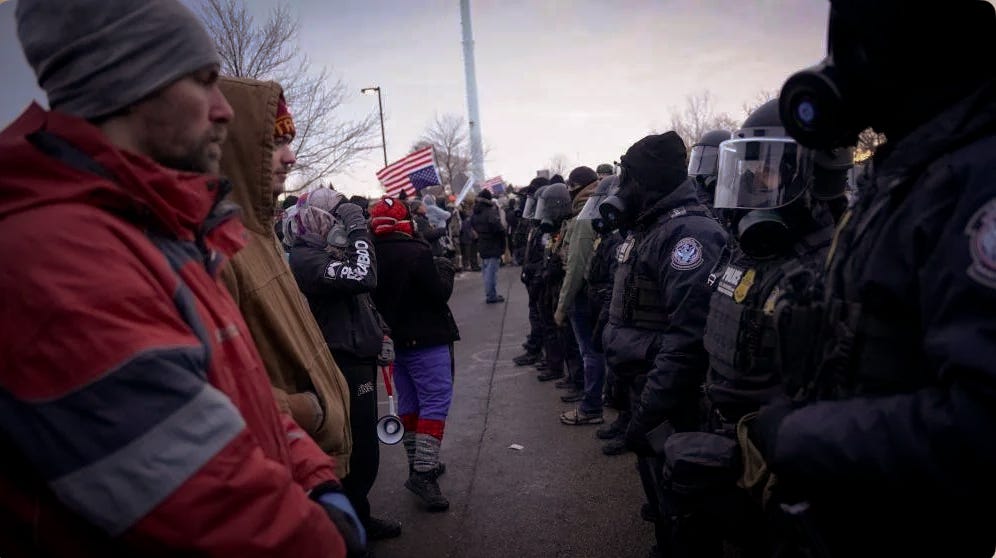
On July 7, 2025, federal agents on horseback moved through MacArthur Park in Los Angeles. Ninety National Guard troops, seventeen Humvees, tactical gear, children rushed inside from summer camp. The operation lasted an hour. No arrests were made.
This wasn’t immigration enforcement. It was a demonstration: federal authority establishing it could occupy American cities without operational purpose and face no immediate consequence. Mayor Karen Bass showed up, confronted the agents, demanded they leave.
No federal investigation followed. No accountability.
Just the precedent.
Six months later: Minneapolis
January 7, 2026. An ICE officer shoots and kills Renee Nicole Good, a 37-year-old U.S. citizen and mother of three. She’s sitting in her car near her son’s elementary school, part of a community network using whistles to alert neighbors when ICE is nearby. The officer fires three shots in under 700 milliseconds. Good dies instantly.
Mayor Jacob Frey watches the video, holds a press conference: “Having seen the video myself, I want to tell everybody directly that is bullshit. To ICE, get the fuck out of Minneapolis.”
Governor Tim Walz delivers a statewide address demanding an end to what he called an "occupation" by federal agents. Both men file federal lawsuits invoking the 10th Amendment.
Nine days later, the Justice Department opens criminal investigations into both Walz and Frey for “conspiring to impede federal immigration agents through public statements.” Grand jury subpoenas are issued.
The only person not under investigation: the ICE agent who shot a U.S. citizen three times in under a second.
Next: The Norway letter
January 18, 2026.
The President sends this to the Prime Minister of Norway:
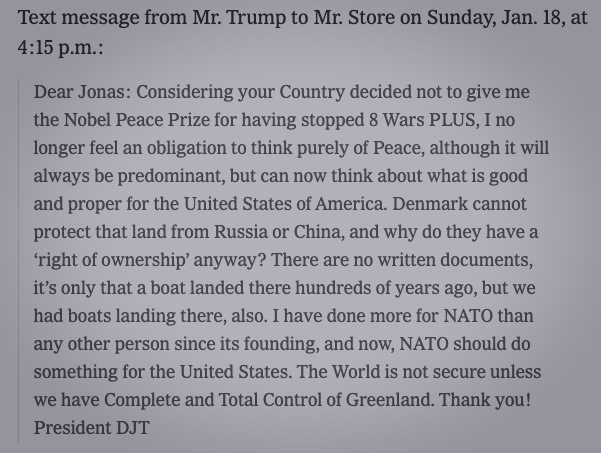
He believes he stopped eight wars he didn’t stop. He believes Norway controls a prize they don’t control. He believes this justifies threatening to invade Denmark, a treaty ally, to seize Greenland, whose residents are Danish citizens.
MacArthur Park to Minneapolis to Norway
From federal occupation of an empty park, to killing a U.S. citizen, to criminalizing the officials who objected, to threatening allied democracies over imaginary slights.
That’s not three separate stories. That’s one pattern, escalating at a tempo conventional analysis can’t process.
Because conventional analysis still assumes:
Power pursues recognizable objectives
Actions connect to strategic goals
Leaders operate within shared reality
Institutions translate exposure into accountability
MacArthur Park had no objective except demonstrating federal supremacy.
Killing Renee Good had no purpose except asserting that supremacy through violence.
Investigating Walz and Frey served only to criminalize dissent.
The Norway letter reflects pure narcissistic injury unconnected to any strategic interest.
This is what I tried to explain in July. This is what people in positions of power couldn’t process. Not because they were stupid or complicit, but because they were still using frameworks designed for a system where madness gets corrected at the ballot box, where overreach creates electoral backlash in predictable cycles, where the gap between action and consequence is long enough for voters to register what happened and respond.
That system is gone.
And the people who should have recognized it first, myself included, kept using the old blueprints long after they stopped describing the structure we were inside.
That’s what I learned between MacArthur Park and Minneapolis. Not that the system is broken—that would imply it could be fixed. But that it’s been swapped out entirely, and the tempo of that swap exceeded our capacity to recognize it until the pattern became undeniable.
By which point, of course, it’s already too late.
Institutional Reflex
When federal force began operating inside American cities in ways that bypassed traditional checks, I reached out to veteran political operatives I had worked alongside for years. I proposed something modest: support constitutional challenges early, before normalization set in. The response was immediate and uniform.
“The courts will handle it.”
“The midterms will correct it.”
“This is how the system works.”
I raised the same concern directly with senior Democratic leadership. I argued that this was not episodic overreach but a change in how power was being exercised—faster, more centralized, and less constrained. I was listened to. There were nods.
Then a fundraiser handed me a business card.
What struck me was not hostility or cynicism. It was institutional reflex. Everyone was acting competently, confidently, and completely out of sync with reality. The assumption—shared across operatives and leadership alike—was that process would eventually discipline power. But power was no longer waiting.
These encounters mattered because they revealed something stark: the people tasked with defending democratic norms were still operating as if norms, by themselves, still governed events.
That framework describes a system where outcomes may be bad but the architecture is stable. Where power is pursued through institutions, not around them. Where the gap between threat and response is measured in election cycles and legislative sessions.
I was trying to describe something different: a system where the architecture underneath had already been replaced while everyone kept confidently navigating using the old maps. Where the tempo of authoritarian escalation was moving faster than institutional response could form. Where by the time you’d identified the threat and scheduled the meeting and coordinated the response, three more precedents had been set and you were already solving yesterday’s crisis.
The Moment the Map Failed
For most of my professional life, I operated inside a stable set of assumptions about how democratic systems bend under pressure.
If something broke, you sharpened the message. If norms were strained, you mobilized allies. If power overreached, courts or press or elections eventually intervened.
This wasn’t naïveté. It was the operating logic of a system that, for decades, corrected itself—slowly, imperfectly, but visibly. You could feel the lag, sometimes measured in years, but you trusted the arc. The system metabolized excess. The guardrails held.
Over the course of 2024, that assumption began to fail. Not suddenly, but steadily.
I spent that year teaching campaign strategy and political messaging: walking students through persuasion models, narrative framing, campaign ads, polling data. On paper, the frameworks still made sense. In practice, they increasingly did not.
The campaign itself was becoming analytically absurd, yet the surrounding machinery—punditry, strategy decks, “both sides” commentary—continued to treat it as politics as usual.
The dissonance was hard to ignore. Harder still to inhabit. To analyze a system honestly while being expected to perform neutrality inside it creates a particular kind of strain. But the work required it. So the rituals continued, even as it became clear they no longer described the thing they claimed to govern.
At the end of the semester, I told my students something I meant less as a warning, and more of an observation drawn from doing this work for almost three decades: “Campaigns are theater; governing is reality.”
One month later, governing began. Federal troops appeared at MacArthur Park. And the distinction between theater and reality collapsed entirely.
When Speed Becomes Power
If you want to understand how political power actually works now, look at California’s Proposition 50.
August 2025: Trump administration works with Texas Republicans on aggressive congressional redistricting.
August 21: California legislature passes legislation putting Prop 50 on the November ballot—allowing Democratic-controlled legislature to redraw congressional districts, abandoning the independent commission.
November 4: Prop 50 passes with 71% of the vote.
Total elapsed time: 75 days.
The “Yes” campaign spent $123 million. Obama, AOC, Pelosi. The full Democratic celebrity apparatus. The “No” campaign spent $44 million, backed by Charles Munger Jr.—whose family created California’s independent redistricting system. Arnold Schwarzenegger opposed it. Good government groups raised substantive concerns.
They lost by 30 points.
Why? Because the “Yes” campaign operated at quantum tempo. By the time the opposition was making deliberative arguments about governance reform, the election was already over. Celebrity surrogates generated algorithmic amplification. The narrative was set: Trump is rigging elections, this is how we fight back.
The “No” campaign never had a chance. Not because their arguments were wrong—because arguments require time to land, and time is what quantum-tempo campaigns eliminate.
I spent four hours on election night analyzing these results on live television.
We discussed demographics, turnout models, regional variations, what it means for 2026. We analyzed politics like it was still 2012. Candidates and messages and coalitions.
But that’s not how any of this works anymore.
What Teaching Looks Like Now
I teach strategic communications and advertising. Every semester, I assign case studies about successful campaigns—brand launches, public advocacy, crisis management. Message discipline. Strategic planning. Long-term thinking.
And every semester, I watch students absorb these lessons and then enter a field where those skills have become insufficient. Not irrelevant—but insufficient for a world where execution speed matters more than strategic precision, where algorithmic distribution determines reach more than message quality.
After MacArthur Park, after Minneapolis, after the Norway letter, I’ve had to reckon with what my actual job is now. Not to prepare students for the political system I came up in—that system is gone. But to teach them to see clearly what’s replacing it.
To recognize when deliberation has become a liability because the other side is operating at speeds deliberation can’t match. To understand when institutions are describing themselves rather than governing reality. To know the difference between strategic patience and structural paralysis.
To document what they’re seeing, because future historians will need witnesses who saw clearly.
This is harder than teaching persuasion models. It requires admitting that much of what I spent twenty years doing describes a world that’s increasingly hard to find. But it’s more honest. And in a profession drowning in performance and pretense, honesty itself has become a form of resistance.
Revolt With a Smaller Radius
I don’t have a five-point plan for fixing any of this. I’m not sure there is one within the existing framework.
What I do have is something smaller, more stubborn, and frankly more attainable: a refusal to pretend this is normal.
Revolt, for me, doesn’t look like a manifesto or a new party or a clever messaging strategy. It looks like:
Teaching students that their job is not to glamorize power but to interrogate it. Not to optimize their relationship with algorithmic systems but to understand how those systems shape what can be said and thought.
Naming authoritarian escalation for what it is. MacArthur Park wasn’t a “botched raid.” Minneapolis isn’t “aggressive enforcement.” The Norway letter isn’t “Trump being Trump.” These are symptoms of power operating without contact with reality, backed by the full apparatus of the state.
Refusing to reduce complexity to tribal binaries. My father—who I wrote about after he died in December—spent his life as an old-guard conservative who ultimately bet on Trump as a wrecking ball. That doesn’t make his choice right. But it makes it human in ways our current moral sorting algorithms don’t allow for. Understanding that complexity is essential to understanding this moment.
Protecting spaces where human judgment still matters more than engagement metrics. Whether that’s a classroom, a conversation, or a piece of writing that takes longer than algorithms reward.
Telling the truth about where we are, without handing despair as an inheritance. My students are entering a world where the rules I learned don’t apply. But despair guarantees surrender. Camus taught us to imagine Sisyphus happy—not because the struggle has meaning, but because refusing despair is itself resistance.
I don’t know if any of this will save anything. I don’t even know if “saving democracy” is the right frame anymore, or if we’re already somewhere else entirely and just haven’t named it yet.
What I do know: I can no longer participate in the pretense that the old frameworks still describe what’s happening.
Where From Here?
“Now this is not the end. It is not even the beginning of the end. But it is, perhaps, the end of the beginning.”
—Winston Churchill, November 1942
The architectural swap is complete.
We saw federal troops ride through MacArthur Park on horseback, past playgrounds where children had been playing, for no operational purpose except to demonstrate they could.
I tried to sound alarms in professional settings designed to process exactly this kind of threat, and watched those warnings dissolve into polite obliviousness.
I taught persuasion models during an election cycle that made those models analytically absurd.
I watched Minneapolis go from Renee Good’s killing to criminal investigations of the officials who objected—in nine days.
I read the President’s letter to Norway and recognized what I’d seen at MacArthur Park, scaled to international relations: power unmoored from reality, moving at speeds that bypass every deliberative check.
Churchill spoke those words after the first significant Allied victory in World War II—not celebrating triumph, but recognizing a shift in the architecture of the conflict itself. The long retreat was over.
What came next would be different.
MacArthur Park was that moment. Not the beginning of democratic decline—that had been happening for years. But the end of the beginning. The moment the new rules became operational. The moment when pretending the old system still governed became impossible for anyone actually watching.
The system I’ve spent my professional life inside—analyzing it, teaching it, sometimes trying to reform it—has been replaced. The building is still standing, people are still going to offices, the procedures still exist on paper. But the architecture underneath is gone.
I’m done pretending otherwise.
I’m still teaching. Still analyzing. Still writing. But not as someone trying to fix a broken system from within. As someone documenting what happened to that system as it failed. As someone teaching students to see clearly rather than operate successfully inside frameworks that no longer describe reality.
Not as a pundit offering solutions. Not as a strategist mapping paths forward. Not as someone who believes the old tools will work if we just apply them correctly.
MacArthur Park to Minneapolis to Norway. From federal troops in Los Angeles to criminal investigations in Minnesota to threats against Denmark. From constitutional precedent shattered domestically to treaty obligations subordinated to narcissistic injury internationally.
The through-line isn’t complexity. It’s madness moving at the speed of state power, and a system with no mechanism to stop it because the mechanism assumed sanity.
The guardrails didn’t fail. They were designed for a different building entirely.
That’s what the architectural swap means.
To those of us who lived through WWII, what is happening now is not unfamiliar. The reaction of my generation was to blame our elders. How did you let this happen? It really took a long time for me to recognize that in fact our elders had no agency. Once the tyrant was in power, political opposition was rapidly disempowered. Trump’s re-election served as a permission slip to exercise unlimited powers, in that it served to erase January 6 and his losses at trial, first of all, and as a retrospective sanction of everything he tried to do in his first term and during the interregnum.
The only thing that can guard the public interest is the rule of law. But then reality sets in: “There must be in-groups whom the law protects but does not bind, alongside out-groups whom the law binds but does not protect.”
—Frank Wilhoit.
David French, writing in the NYT: “And so we’ve slowly but surely created the mechanisms of what the Nazi-era Jewish labor lawyer Ernst Fraenkel called “the dual state.” There is the normative state where the ordinary rules and procedures apply, and then there is the prerogative state marked by “unlimited arbitrariness and violence unchecked by any legal guarantees.” According to Fraenkel, dictatorships create a lawless zone that runs alongside the normative state.”
In that model, where we are heading is clear. All opposition to Trump will come to be subjected to the arbitrariness and violence of the prerogative state. We are nearly there.