
The Feudal Feed
We think we’re still living in the age of social media. We may have already left.

There’s a moment in medicine when a doctor finds something on a scan and the conversation changes. Not a death sentence. A diagnosis. The thing you can no longer pretend isn’t there.
That moment arrived for social media recently. And like most ruptures, it happened faster than anyone expected.
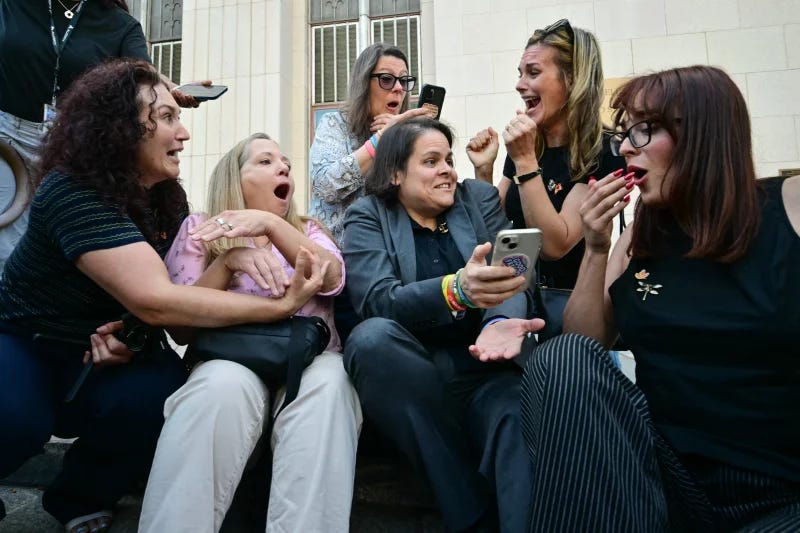
A Los Angeles jury found Meta and YouTube liable for knowingly designing products to addict children. The judge had already ruled that algorithmic feeds, autoplay, and push notifications were valid targets — not the content users posted, but the design itself. The jury found malice.
I was teaching when it landed. I put the verdict in front of my students — people literally preparing to enter the industry the jury had just diagnosed — and we talked about what it means. I’m writing it here because the industry’s own internal logic has finally become visible to people outside it. And they didn’t like what they saw.
I’d assigned my students a piece from James O’Sullivan in Noema magazine called “The Last Days of Social Media.” I strongly suggest you read it. His thesis? Social media is collapsing into an AI slop ecosystem where synthetic content and algorithmic optimization have severed the human social contract.
He wrote that in September 2025.
How’s your feed looking about now - seeing much “AI slop?”
Cornell law professor James Grimmelmann called the decision “a brick in a potential wall.” That’s accurate. Not the wall itself — a brick. But here’s what that brick showed: a jury of ordinary people, after six weeks of testimony and internal documents and platform engineers on the stand, as well as an appearance by Mark Zuckerberg, concluded that Meta knew its product was harming children, engineered it to be more addictive anyway, and concealed what it knew.
We’ve seen this before. Not with social media — but with another industry that knew its product caused harm, buried the evidence, and kept selling.
The tobacco comparison isn’t perfect. But what cracked Big Tobacco wasn’t one case. It was the accumulation of cases, the internal documents, the moment juries started believing plaintiffs over executives.
That clock has started.
The Ghost of the Fourth Paradigm
I first encountered Raja Rajamannar’s framework for marketing paradigms when I started teaching. It has been my de-facto textbook ever since. His map is simple and powerful: decades of product-based advertising, then the emotional Mad Men era, then the internet’s precision targeting. Then the fourth paradigm — social media. A world where the medium wasn’t a channel you bought time on. It was a place people lived.
That paradigm began around 2007. It lasted less than twenty years.
The thing about paradigm shifts is that they are invisible from the inside. The metrics we track — impressions, likes, engagement — are calibrated to the world that’s ending. We are using the language of a 2015 social contract to describe a 2026 extraction economy. The fourth paradigm isn’t just failing. It’s being hollowed out by agentic AI and algorithmic slop that has severed the human connection it originally promised.
The Seduction of the Serf
Yanis Varoufakis argues that we have quietly drifted into techno-feudalism. The market has been replaced by the fief. We are no longer consumers — we are digital serfs tilling the algorithmic soil. Every post, every scroll, every like is a crop we harvest for the Landlord, who rents our attention back to the highest bidder.
Here’s the specific psychological trap that makes the Feudal Feed so effective. In a traditional fiefdom, the serf knew they were exploited. In the digital fief, the serf feels empowered. That’s a bad deal.
Gallup data released just this week captures this perfectly: heavy social media users feel twice as represented by their government as non-users. 31% of heavy users feel represented by their government versus 15% of non-users. The gap tells the whole story.
This is the genius of the design.
The system doesn’t silence you. It seduces you into believing you have a voice while it harvests your data. You feel like the sheriff of your own feed.
You’re still just working the landlord’s field.
The platforms didn’t build this architecture alone. The same consolidation of power reorganizing our politics has reorganized our information environment. The Houses don’t just control political power. They control the pipes through which info flows. That’s not a coincidence. That’s the design.
The Great Enclosure
There is something else funny going on.
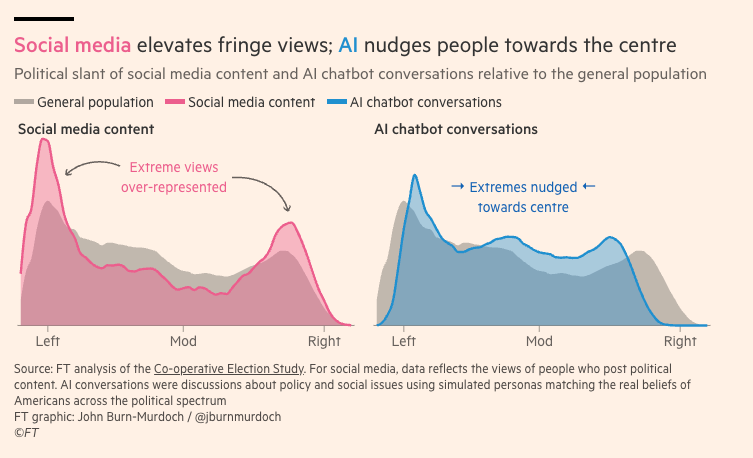
Social media spent fifteen years radicalizing you. Pushing you toward the fringe. Keeping you outraged because outrage kept you scrolling.
Now AI may be being used to walk it back. To nudge you toward the center. To correct what they spent a decade engineering.
They broke the thing. Now they’re selling you the fix.
But here’s what they’re not telling you: the fix requires the same compliance as the original product. Your specific anger, your specific identity, your specific feeling of being heard — that’s the statistical outlier now. The algorithm will smooth it out. For your own good.
The question nobody is asking: will people trade the feeling of being heard for the feeling of being stable?
It’s not a technology question, it’s a power question.
Tending the “Billion Little Gardens”
Facebook and X posts now reach 0.15% average engagement. Instagram down 24% year on year. The content proliferates. The connection evaporates. You’re scrolling through a ghost town that keeps sending you notifications.
Meanwhile something else is happening. People are building elsewhere — Substacks, Signal groups, Discord servers with actual rules and actual humans. O’Sullivan calls them “a billion little gardens.” Communities where the metric that matters isn’t impressions but whether you showed up again next week.
That's not the future of social media. That's already the present. And it's where the next paradigm is being built — through a billion small acts of deliberate connection.
The Blueprint
Here’s what I told my advertising and media students when the verdict landed: you are not inheriting a broken industry. You are inheriting a diagnosed one. That’s different. Broken means keep fixing the same thing. Diagnosed means you finally know what you’re dealing with — and that knowledge is the only real foundation for building something new.
You’re not too late. You’re exactly on time.
You are entering this industry at the exact moment the scan came back with something on it. That is not a reason for despair. It is the most clarifying thing that could happen to a generation of practitioners — because it means the question of what to build next is genuinely open in a way it hasn’t been in twenty years.
The fourth paradigm is not dead. But it is finally understood. And in that understanding lies the freedom to build what comes next.
We are moving from the age of the Platform to the age of the Architect.
It’s time to start planting. The Landlord doesn’t own the seeds.