
The Table
What a UK political podcast at 1 a.m. reminded me about everything American politics has lost

I came to Europe a few weeks ago wondering what people here thought of America.
I learned more about America by being here.
1:00 AM. Valencia, Spain. A town that feels more West Coast than most places in Europe. Not LA, but maybe a bit “San Diego.” A different hotel room but the same routine. A day spent negotiating train stops, taxis and exchange rates.
Hint: the dollar sucks.
I put in my earbuds — not to fall asleep. I was past that. I wanted to see what was up in the world.
The Rest Is Politics. I’d had the name wrong in my head for days — kept calling it The Rest Is History, its sister show — until I listened last night and realized the correction mattered. This wasn’t historians narrating the distant past. It was the hosts Alastair Campbell and Rory Stewart dissecting a parliamentary election result that had landed hours earlier.
Two former political hacks. Both at least a decade older than me, but contemporaries in every way that counts — they came up through the same era of the game I did, just with a slightly different set of rules.
Campbell ran communications at the top of his government the way I ran rooms somewhere in that vicinity. Stewart sat in Parliament and lost his own party from the inside. Their accents make the whole enterprise sound posh, almost theatrical. But underneath the poshness is something I recognized instantly: real curiosity. Real excitement, deconstructing the moves.
The sound of two people who’ve been inside the machine and still, genuinely, can’t wait to find out what happens next.
I knew almost nothing when I landed in Europe. Starmer, Labour, Reform — names I knew certainly, but without any real weight.
And I lay there in the dark, fascinated.
Not informed.
Not analyzing.
Fascinated.
The particular electricity of people who clearly love the game discussing a result that actually could have gone either way. Coalition math. Wounded egos. A leader whose position was genuinely, structurally uncertain — not performed uncertainty, not manufactured suspense for a streaming platform, not delirious rants from influencers on the right and the left, but the real thing: nobody knew for certain what came next, and you could hear them not knowing, and loving the not-knowing, the way you love a sport whose outcome hasn’t been fixed.
I hadn’t felt that in years. Not about my own country’s politics. Not once.
One detail stayed with me longest, the one I kept turning over after the episode ended.
John Healey, the Defence Secretary, had resigned days earlier — not pushed, not caught in scandal, but walking out the door because he couldn’t put his name to a defence spending plan he believed left Britain dangerously underprepared at a moment of rising threats from Russia and elsewhere. He said so in a letter, in public, and meant it enough to give up the job over it.
He set the letter to his boss. The Prime Minister. From his own party.
And days later, Andy Burnham — the Mayor of Greater Manchester and Starmer’s most credible internal rival — won a special election by a landslide, in a seat his own party’s sitting MP gave up specifically so Burnham could run for it, with turnout actually higher than the last general election in that constituency.
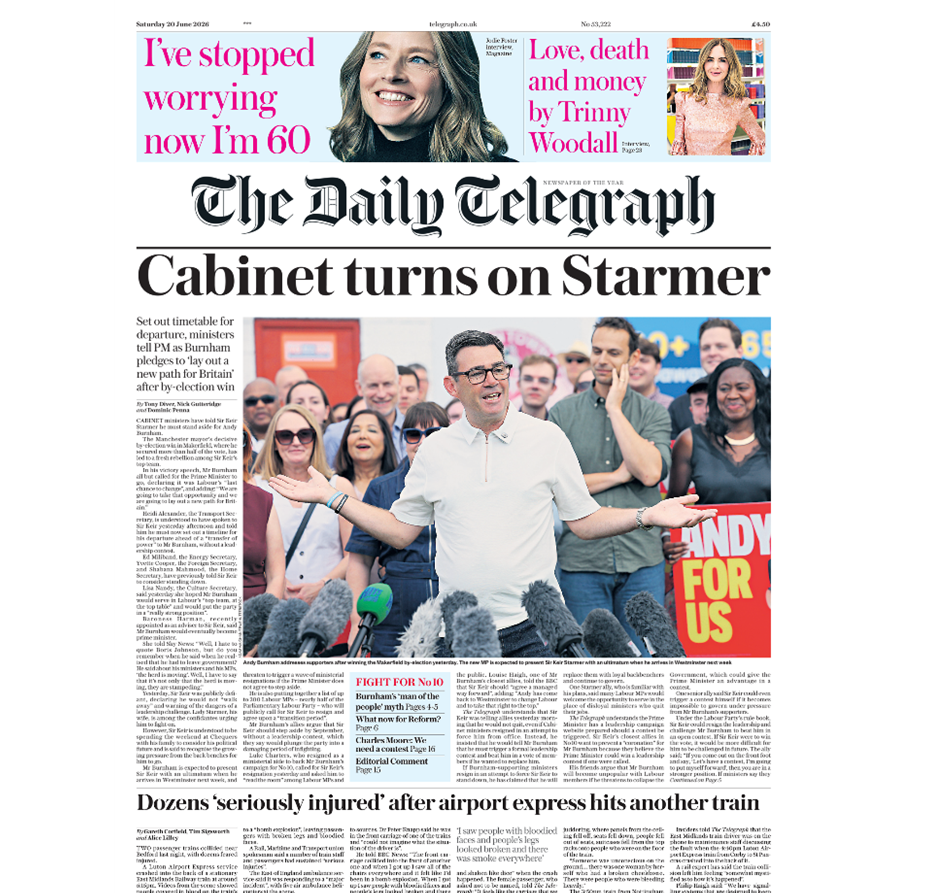
The message wasn’t subtle: voters showing up in numbers nobody expected, handing Starmer’s chief challenger exactly what he needed to mount a real leadership fight.
Two different kinds of consequence, days apart. A minister who quit because he couldn’t live with a decision. A government that may lose its own leader because voters told it so, directly, with their feet, at a turnout governing parties dream of avoiding. And the way Campbell and Stewart discussed both, there was an assumption sitting underneath the conversation I didn’t immediately register because it’s so absent from how I think about my own country: that this was the system working. A message sent — by a colleague to his own government, and by voters to their own party.
The system absorbing it, in public, in real time, because the cost of pretending otherwise was higher than the cost of an uncomfortable headline.
I sat with that for a long time in the dark.
In America right now our cabinet is a clown-show. A circle of sycophants — people who got their seats largely through money, who keep their seats through performance, and who lose their seats almost never through anything resembling a party’s own self-correction. Scandal doesn’t end careers anymore. It barely interrupts news cycles. There is no mechanism — none — by which a party says to its own: this was a bridge too far, and there will be a cost.
If that mechanism existed on the Democratic side right now, Chuck Schumer and Hakeem Jeffries would be standing in line for it too. Not because of scandal in the British sense. Because of failure to use the power they have. A failure of nerve dressed up as strategy with worthless terms like “affordability” and “abundance” and “accountability.”
Some of this is structural. Coalition governments, shadow cabinets, parliamentary systems built for exactly this kind of internal accountability in a way our two-party presidential system was never designed to replicate. I understand the architecture is different. But underneath the architecture is an attitude, and the attitude is the thing worth stealing even if the mechanism doesn’t translate.
The willingness to say, out loud, inside your own party: that was unacceptable, and there will be consequences, starting with us.
I don’t hear that attitude anywhere in American politics right now. I hear something closer to whimpering — the sound of a party that can see something is wrong, says so in careful, hedged language, and then does nothing that would cost it anything to actually fix.
In 2024, I taught political communication during an American election cycle, in front of rooms of sharp, ambitious young students. And instead of analyzing strategy — the thing I was actually there to teach — I found myself in the agonizing position of having to halfway defend the baseline mechanics of reality.
I had to stand at a podium and help twenty-year-olds parse a presidential candidate standing on a debate stage claiming that Haitian immigrants were literally stealing and eating people’s pets in Springfield, Ohio.
I had to explain why a frontrunner calling his political opponents “treasonous” and declaring they should be jailed wasn’t just a spicy piece of campaign rhetoric — that it wasn’t normal.
To make the psychic friction worse, I was co-teaching the course with a long-time former Republican turned “independent” who spent the semester trying to rationalize those moments to the kids, treating authoritarian threats and xenophobic fabrications as completely valid, standard-issue political tactics.
It was exhausting. It felt less like teaching a discipline and more like trying to hold up a collapsing wall with my bare hands while someone next to me argued the wall was supposed to be crooked.
I have been reading Democratic-aligned analysts this week talking about a vibe shift. Small wins. Polling movement. Trump’s numbers ticking down a few points here, a swing district trending differently there. The tone of relief in this commentary — the sense that the worst might be passing, that the fever might be breaking — is, to put it as bluntly as I can manage: bullshit.
A poll moving two points is not a correction. It is not what it takes to fix where we actually are. It has nothing to do with the architecture — the captured courts, the redrawn maps, the IRS settlement that immunizes a family from its own government, the trillionaire infrastructure that answers to no electorate anywhere.
Vibes don’t reach any of that. Vibes are the opiate you reach for when the actual diagnosis is too large to sit with, and I recognize the reach because I’ve made it myself, more than once, in this very Substack.
Anyone else remember the Kamala and Charli XCX 'brat' moment?
This is what I mean when I talk about the difference between weather and geology. A two-point swing is weather. It will pass, or it won’t, and either way the geology underneath it — the thirty-year project that built the courts, the architecture that replaced the institutions — doesn’t move an inch because Trump’s approval rating ticked down in June.
The easy version of this essay is nostalgia, and nostalgia is a lie I’m not interested in telling.
It would be easy to say: politics used to be fun, and now it isn’t. That’s not it. The drama I heard in that podcast — the intrigue, the real fuckery, the genuine stakes — is the same drama that made me fall in love with this work in a gym during the Iowa caucus decades ago.
Different country, different language of politics I’m still learning, but the same animating current.
Real contest. Real uncertainty. Multiple parties actually fighting for actual power, with actual paths to losing it, and actual mechanisms for holding their own accountable when they failed to use that power well.
That thing isn’t gone from the world. I was lying in a bed in Spain at one in the morning, proof of its life humming through my earbuds, delivered by two guys who’d spent their careers inside the same kind of rooms I had.
It’s gone from America.
What I sat with afterward was this: the form still exists. Somewhere. The uncertainty, the genuine multiparty fight for genuine power, the willingness of a party to discipline itself — all of it alive and well in a country I’d arrived in a week earlier knowing almost nothing about its politics.
Which means what I lost wasn’t politics. It was my politics. The specific American version. And it didn’t disappear because politics itself became less interesting. It disappeared because the contest stopped being a contest, and because the accountability stopped being accountability.
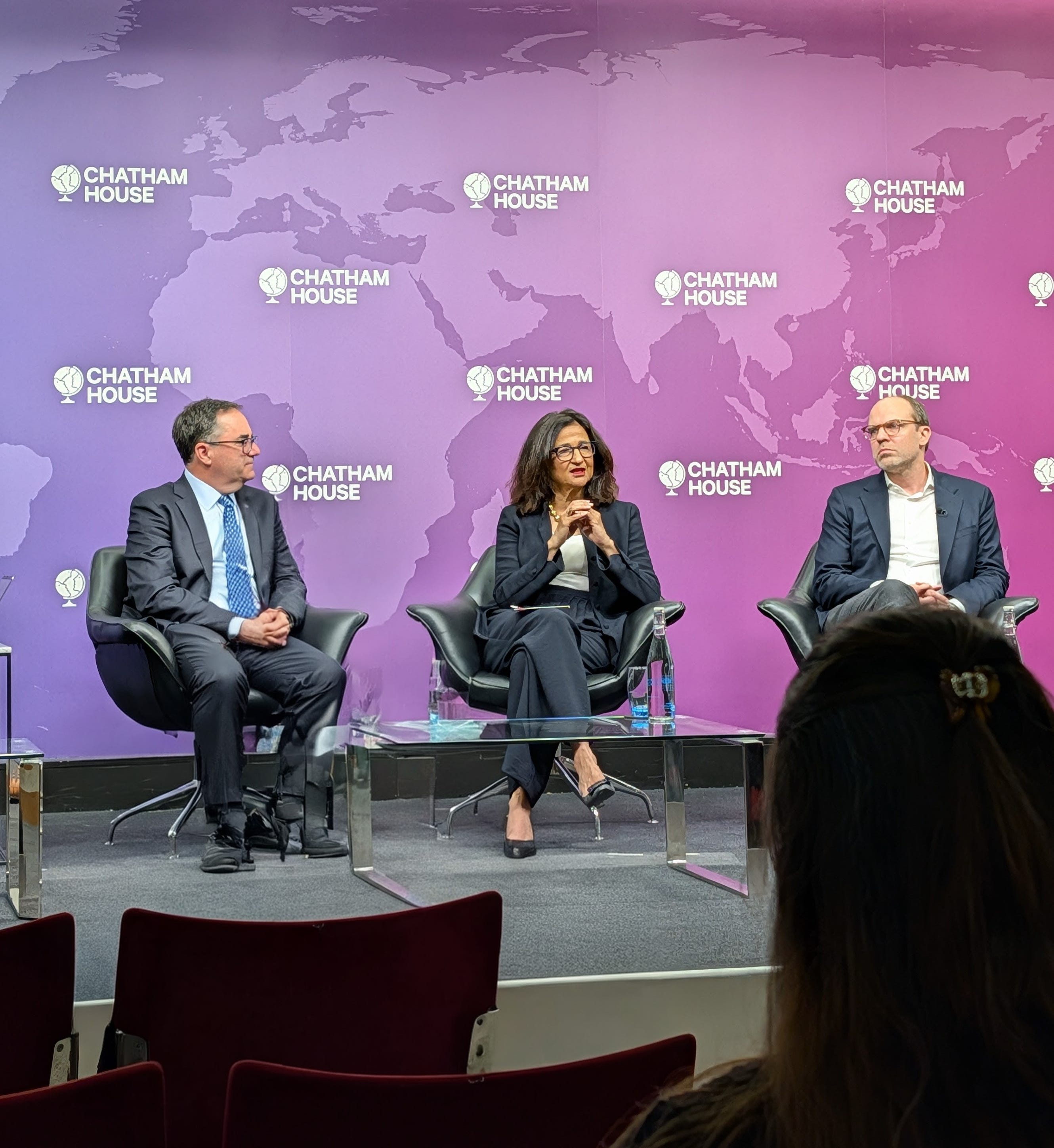
A few days before that night, I’d sat in a different room — Chatham House, London — listening to Baroness Minouche Shafik, Keir Starmer’s chief economic advisor, argue from the stage that we should apply the lessons of globalization to the challenge of AI. Nations coordinating. Treaties, summits, the slow, imperfect machinery of shared management.
And then Donald Trump did what he does: pulled the rug out from under her, and everyone else in that room, before the week was even over. One unilateral directive. No summit, no memorandum, no convening anyone agreed to. The table the Baroness was describing doesn’t exist.
America has a building that looks like a table anyway. Same flags, same vocabulary, same cable news set dressing — the same physical grammar The West Wing borrowed to sell its fantasy of noble, consequential politics.
I never bought that show. Guys like me, already hardened by the time it aired, thought it was too manicured, too pleased with itself. But even a knowing fantasy needs something to be nostalgic for, and the premise underneath all that velvet lighting was that the stakes were real — someone could win, someone could lose, and it would matter. That’s the part I miss. Not the manicured nobility. The assumption that the outcome was actually in play.
Increasingly, it isn’t — and no one pays the kind of price that minister paid.
Musk crossed into trillionaire status this month through infrastructure no democracy has built the tools to discipline.
The administration settled its own lawsuit against its own government this spring and granted itself and its family permanent immunity in a document nobody voted on and nobody can undo.
The Voting Rights Act, born of actual blood, became dead letter this spring, by a court placed there for exactly that purpose, by people who never had to face a single voter to do it. Nobody resigned over any of it. Nobody lost a primary over any of it. These aren’t actors inside a contest with consequences. They’re the reason consequences, at their level, have stopped existing.
You can’t get that electricity, the one I felt at 1 a.m. in Valencia, from a fixed fight.
You can perform it — cable news does, nightly, with graphics and countdown clocks — but performed uncertainty isn’t uncertainty. It’s theater built over the absence of the real thing, and at some level, audiences know it.
All of this made me sad. I guess it could be considered grief.
It is not grief for democracy as an abstraction. It’s not even, primarily, grief for the country, though that’s bound up in it too. It’s something smaller and stranger: grief for a feeling — the same one that first pulled me into this work, in an Iowa caucus, decades before I had language for any of it. I didn’t know it then, but I was tending something larger than any single campaign — a set of institutions and habits and democratic rituals that assumed good faith, assumed accountability, assumed the machinery connecting citizen action to political outcome still worked.
It did work. Then. I didn’t know yet what it would cost when it stopped.
That’s the feeling I lost. Not politics as a hobby. The transmission itself — organizing leading to votes leading to consequence, the wiring intact end to end, and a system willing to discipline itself when it failed.
I found all of it humming through a podcast at 1 a.m., alive and well in a political system I know very little about. And finding it there confirmed what finding it nowhere at home had only suggested: the fuel still exists in the world. It just isn’t burning here anymore, not the way it used to, not the way that matters.
Whether it can be relit — whether the structural work being proposed in pieces like the various “Reconstruction” agendas making the rounds, or the political work of an actual midterm, or something none of us has thought of yet, can restore a contest that’s genuinely contestable — I don’t know. I’m not offering a solution tonight. I’ve mostly stopped offering those.
What I have is the data point. The 1 a.m. proof. Somewhere, right now, the real thing is still happening, with real stakes, real accountability, and a real outcome nobody can yet call.
I’m flying home tomorrow.
I don’t know yet what it will feel like to land.
P.S. — I wrote all of this in the dark, not knowing how any of it ended. Somewhere between finishing this and actually pressing send, Keir Starmer resigned. Burnham is the overwhelming favorite to replace him. The system did exactly what Campbell and Stewart assumed it would do, the thing I’d forgotten a system could do at all: it held someone accountable, in public, on schedule, with consequences attached. I didn’t see that coming with this kind of precision. I just happened to be listening, at 1 a.m., to two men who already knew the table was real.
This is a terrific post, and an important observation. To a certain degree, it reflects what has always been true of the difference between parliamentary and first-past-the-post winner take all democratic systems: there is an immediacy to the politics of European nations that a country with a fixed election schedule and only two dominant parties, no fluidity, can never match.. The US, even when before its autocratic turn, always moved at ponderous speed, and with the same cast of characters for generations (with a Clinton, Bush, or Biden on a presidential ticket for forty years). And another difference is ideological-- Europeans live their politics, and class and labor matter far more than the US, which except for a brief time after WWII was ruled by business, aristocrats, and technocrats-- despite European aristocratic lineage actual participation in US politics has been far more elitist than its counterparts. Plus religion, and specifically the Christian nationalism that has always been near the surface in the US but now is prominent, always plays a bigger role than in modern Europe.
Here's the rub, or the payoff, however: I think you make a characteristic mistake in equating Republican fealty to Trump with the Democratic Party's caution and unwillingness to rebuke a Schumer or Jeffries. For a whole number of reasons: first, whatever Americans and younger Americans say to pollsters, they are simply less ideological and less informed about politics than Europeans, across the board. They typically know far less about US politics than Europeans know about Americans , factually speaking. Americans want to make money and to be left alone--they are motivated by what Michael Schudson called "delectable materialism." That, not ideology, is the unifying force. So when you push too hard politically, or go deeper than the "affordability" you scorn, you alienate more voters than you bring over, at least to the present. (I'm a professional political consultant-- I can prove this to you in discouraging but real detail.) Schumer and Jeffries, especially the latter, who knows and has said that we are in a war for our country, are operating with constraints as well, namely the actual makeup of their voters, who are more progressive than before but still far from a majority. The Democratic Party is a congeries of voters and interests who have relatively little in common except fairly inchoate beliefs in economic growth, protection of privacy, and freedom from fear by the state. With the actual makeup of the Party in mind, the Congressional leaders have done quite an amazing job with little real power-- going as far as they could in the shutdowns, and, in retrospect (despite catching a lot of flak) picking the right issues and battles to wage.
Also, Democrats have policied their ranks, with respect to scandals and to their values, if anything to excess, as with Al Franken. The only real deviations from this were Ralph Northam in Virginia and Bill Clinton himself, and Northam played no real role going forward. And if you mean political rebukes, when it comes to policy at least at the moment I challenge you to tell me how the policies of a future Senator Platner will deviate from those of a Sherril or Spanberger or Slotkin. They won't. And if they are more anti-capitalist, I suspect they weill be short-lived. What passes for radical even among Democrats is modestly social democratic, maybe not even moderate left, by European standards, and given the actual makeup of the party and the polity that makes sense. The Democratic Party is a huge tent, and perhaps not even big enough by my lights, and I wish that instead of running it down ritually (that, by the way, is not what you are doing, but day in and day out I hear nothing else from donors and partisans within the party) we were a bit more complimentary of the skill and different skillsets of its leaders, and less preoccupied with seeking the unicorn who might unite all of them.
What a sad reverie, Steve. Thank you for your frankness and for not giving up on the ideals, however elusive, that brought you into the work originally. They are worth saving, resurrecting, reconstructing, and realizing anew.